


Reptile Safe Plants

Introducing live flora into a terrarium or bioactive vivarium transforms a sterile box into a dynamic, functioning micro-ecosystem. Beyond aesthetic appeal, live plants provide essential environmental enrichment: they naturally buffer ambient humidity, offer cryptic visual barriers that lower stress, shed water droplets for drinking, and create microclimates where reptiles can self-regulate.
Designing a planted enclosure for reptiles, however, involves considerations far beyond standard houseplant care. What thrives on a windowsill may be hazardous or short-lived inside an enclosure. Selecting the right species requires evaluating two equally critical factors: biochemical safety and mechanical resilience.
1. Ingestion Risk vs. Mechanical Impact
The biological habits of your reptile dictate the type of foliage it can safely cohabitate with:
-
Snakes (Strict Carnivores): Snakes will never eat your plants, meaning systemic poisoning from direct ingestion is virtually zero. HOWEVER: When feeding it is important to note, that the snake can accidentally strike at the plant and injest some of the leaf (More on this in the personal story below!). The primary challenge is purely physical. Heavy-bodied terrestrial pythons, active colubrids, and perching arboreals will crush, snap, or uproot fragile foliage within days. For snakes, plant selection focuses on thick, woody stems, tough root structures, and leathery leaves that can tolerate being trampled.
-
Personal Story: I had a 2m long x 1.5m deep x 1.8m tall bioactive enclosure for a pair of green tree pythons. Because they wont eat the plants, I had several varieties of Philodendren in there. These plants had been in there for years with the snakes with 0 complications. However one night, I was feeding my big green tree python female, and she got very excited and accidentally grabbed a philodenron leaf. Philodendrons are toxic if ingested. I panicked because she started producing a CRAP LOAD of saliva. I am talking super excessive amounts. So I grabbed her out and fully rinsed her mouth out, got any bit of leaf out and she was fine. She actually went on to eat her rat right after! Years later and she is still healthy as can be. So just word of warning if you are going to have toxic if ingested plants in your snake enclosure!
-
-
Herbivorous & Omnivorous Lizards: Skinks, dragons ect are inquisitive grazers that will actively taste, chew, and ingest enclosure greenery. For these species, plants must be strictly edible and free of toxic saps, insoluble oxalates, and chemical deterrents.
-
Carnivorous & Insectivorous Lizards: Small geckos and active arboreal monitors often ignore the foliage itself, but sharp claws, climbing activity, and rapid hunting sprints demand plants that can anchor securely to hardscape and regenerate quickly if damaged. It is always best to use non toxic plants in any lizard enclosure.
2. True Non-Toxicity vs. Houseplant Tolerances
Many common houseplants touted as "easy vivarium starters" carry hidden hazards:
-
Sap and Latex Irritants: Species with milky, caustic latex (such as Ficus or Euphorbia) can cause severe skin, cloacal, and ocular irritation upon contact, particularly if a branch is snapped during climbing.
-
Calcium Oxalates: While aroids like Pothos and Philodendron are staple workhorses in bioactive setups for non-grazing animals, their microscopic needle-like raphides cause acute swelling and oral pain if sampled by omnivorous reptiles. Aswell as causing the animal to produce excessive amounts of saliva.
-
Edible & Inert Flora: A truly reptile-safe baseline prioritizes inert species—such as true ferns, bromeliads, palms, peperomias, and edible forest greens—that pose zero threat regardless of contact or accidental consumption.
3. The Golden Rule: Nursery Prep Before Planting
A plant's species may be 100% safe, but its commercial origin often is not. Commercial nurseries routinely treat decorative plants with systemic neonicotinoids, chemical leaf shines, antifungal sprays, and slow-release synthetic fertilizer prills. In the enclosed heat and humidity of a reptile vivarium, these residues can prove lethal to custodial cleanup crews (isopods, springtails) and sensitive reptile skin.
Every plant brought into an enclosure must undergo a thorough preparation process: washing roots down to bare soil, performing an foliage soak, and undergoing a quarantine period in clean, additive-free vivarium soil.
Explore the categorized database below to find plant selections mapped to your specific enclosure biome—from high-humidity tropical canopies to arid woodland terrains.
Enclosure Biomes & Setup Types: Australian Herpetofauna
When designing a planted vivarium for Australian native reptiles and amphibians, matching flora to the specific microhabitat is essential. Because frogs possess semi-permeable skin, plant safety must account not only for mechanical resilience and ingestion, but also for skin absorption risks—making completely non-toxic, sap-free flora mandatory.
1. Wet Tropics Rainforest & High Canopies (Vertical Arboreal)
High-canopy environments replicate the lush tropical rainforests of northern Queensland and the Cape York Peninsula.
-
Environmental Parameters: 75%–95% ambient humidity, frequent misting cycles, warm ambient temperatures, and directional airflow.
-
Featured Australian Inhabitants:
-
Snakes: Green Tree Python (Morelia viridis), Common Tree Snake (Dendrelaphis punctulatus).
-
Lizards: Boyd’s Forest Dragon (Lophosaurus boydii), Southern Angle-headed Dragon (Lophosaurus spinipes), Green Tree Monitor (Varanus prasinus).
-
Frogs: Red-eyed Tree Frog (Litoria chloris), Dainty Green Tree Frog (Litoria gracilenta), Magnificent Tree Frog (Litoria splendida), Green Tree Frog (Litoria caerulea).
-
-
Plant Strategy & Safe Flora: Epiphytes mounted off the ground into cork bark, backgrounds, or branch unions provide shelter without impeding arboreal perches. Broad leaves collect clean water droplets for chondros and tree frogs to lap up.
-
Top Choices: Bird’s Nest Fern (Asplenium nidus), Elkhorn & Staghorn Ferns (Platycerium bifurcatum / superbum), Crocodile Fern (Microsorum musifolium), Native Wax Plant (Hoya australis), native epiphytic rock lilies/orchids (Dendrobium speciosum, D. kingianum), and Bromeliads.
2. Humid Understorey & Wet Sclerophyll (Terrestrial & Floor-Dwelling)
Replicates the damp, sheltered forest floor beneath dense canopy cover, dominated by leaf litter and decaying timber.
-
Environmental Parameters: 60%–80% humidity, deep bioactive soil, thick leaf litter layers, and filtered under-canopy lighting.
-
Featured Australian Inhabitants:
-
Snakes: White Lipped Pythons (Leiopython albertisii).
-
-
-
Lizards: Pink-tongued Skink (Cyclodomorphus gerrardii), Major Skink (Bellatorias frerei), Land Mullet (Bellatorias major), Thick-tailed Gecko (Underwoodisaurus milii).
-
-
-
Frogs: Striped Marsh Frog (Limnodynastes peronii), Great Barred Frog (Mixophyes fasciolatus), Orange-thighed Frog (Litoria xanthomera).
-
-
Plant Strategy & Safe Flora: Deep-rooting, durable foliage capable of withstanding heavy bodies flattening stems and skinks burrowing through the soil.
-
Top Choices: Native Ginger (Alpinia caerulea), Cast Iron Plant (Aspidistra elatior), Native Maidenhair Fern (Adiantum aethiopicum), Rough Maidenhair (Adiantum hispidulum), Native Peperomia (Peperomia tetraphylla / blanda), and Calathea varieties.
3. Temperate Bushland & Coastal Woodland (Transitional / Sclerophyll)
Mimics open eucalyptus forest, coastal heath, and sandstone ridges across eastern and southern Australia.
-
Environmental Parameters: 45%–65% baseline humidity with dedicated moist micro-hides, strong thermal gradients, and moderate-to-bright lighting.
-
Featured Australian Inhabitants:
- Snakes: Carpet Pythons (Morelia spilota species), Diamond Python (Morelia spilota spilota), Spotted Python (Antaresia maculosa), Children’s Python (Antaresia childreni).
-
-
Lizards: Eastern & Northern Blue-tongued Skink (Tiliqua scincoides), Cunningham’s Skink (Egernia cunninghami), Marbled Gecko (Christinus marmoratus).
-
-
-
Frogs: Peron’s Tree Frog (Litoria peronii), Bleating Tree Frog (Litoria dentata), Spotted Grass Frog (Limnodynastes tasmaniensis).
-
-
Plant Strategy & Safe Flora: Resilient generalists with tough, fibrous foliage that tolerate variable watering cycles, lower humidity, and active climbing or trampling.
-
Top Choices: Dwarf Mat-rush (Lomandra confertifolia varieties like 'Little Con'), Native Flax Lily (Dianella caerulea dwarf forms), Parlor Palm (Chamaedorea elegans), Spider Plant (Chlorophytum comosum), and Peperomia obtusifolia.
4. Arid & Semi-Arid Scrub (Red Sand, Rock & Spinifex Deserts)
Replicates the harsh, sun-drenched interior of the Australian outback and rocky ranges.
-
Environmental Parameters: 15%–35% ambient humidity, intense localized basking spots (40°C–50°C+), high-output UVB lighting, and deep red sand/loam substrate blends.
-
Featured Australian Inhabitants:
-
Snakes: Centralian Carpet Python (Morelia bredli), Woma Python (Aspidites ramsayi), Black headed Python (Aspidites melanocephalus).
-
-
-
Lizards: Central Bearded Dragon (Pogona vitticeps), Pygmy Spiny-tailed / Ackie Monitor (Varanus acanthurus), Centralian Blue-tongued Skink (Tiliqua multifasciata), Smooth Knob-tailed Gecko (Nephrurus levis).
-
-
Plant Strategy & Safe Flora: Spineless, non-toxic succulents and arid grasses that can endure direct heat, dry air, and relentless excavation around root systems. Because omnivorous dragons browse on greenery, every plant must be 100% edible.
-
-
Top Choices: Rounded Noon-flower / Native Pigface (Disphyma crassifolium), Elephant Bush (Portulacaria afra), Spineless Haworthia species, Echeveria, and hardy tufted grasses. (Strictly avoid toxic native euphorbias, cacti with spines/glochids, and Aloe vera).
-
5. Riparian Margins & Billabong Wetlands (Paludarium & Semi-Aquatic)
Replicates permanent water bodies, tropical creeks, and slow-moving billabongs where land transitions directly into water.
-
Environmental Parameters: Saturated shoreline substrates, integrated water features, constant high ambient humidity, and warm basking surfaces suspended over water.
-
Featured Australian Inhabitants:
-
Snakes: Freshwater Keelback (Tropidonophis mairii), Macleay’s Water Snake (Pseudoferania polylepis), Common Tree Snake (Dendrelaphis punctulatus).
-
-
-
Lizards: Australian Water Dragon (Intellagama lesueurii), Merton’s Water Monitor (Varanus mertensi), Mitchell’s Water Monitor (Varanus mitchelli).
-
-
-
Frogs: Green and Golden Bell Frog (Litoria aurea), Growling Grass Frog (Litoria raniformis), Stoney Creek Frog (Litoria jungguy / lesueuri), Dwarf Tree Frogs (Litoria fallax).
-
-
Plant Strategy & Safe Flora: Semi-aquatic and marginal bog plants with aggressive root systems that bind shoreline substrate, filter waste compounds, and survive wet claws repeatedly climbing in and out.
-
Top Choices: Water Ribbons (Cycnogeton procerum), Native Water Fern / Soft Bracken, Swamp Lily (Crinum pedunculatum - larger setups), Eel Grass (Vallisneria australis in aquatic sections), and moisture-loving ferns anchored into bog borders
-
In Depth Plant Breakdowns for Each Enclosure Ecosystem
1. Wet Tropics Rainforest & High Canopies (Vertical Arboreal)
&
2. Humid Understorey & Wet Sclerophyll (Terrestrial & Floor-Dwelling)
Epiphytes & Arboreal Mounts (Cork Bark, Branches & Backgrounds)
Epiphytic species can be mounted directly onto cork tubes, background panels, or branch crotches at perch level to provide immediate visual cover and security.
-
Bromeliads (Neoregelia, Guzmania, Vriesea)
-
Role: Canopy & Perch Shielding
-
Placement: Mount into background pockets or secure with floral wire/zip ties directly onto branches near horizontal perches. Their central leaf cups hold misted water, elevating microclimate humidity right where the python rests.
-
Choosing the right type: Make sure the bromeliad has no sharp thorns. Some bromeliad species have very sharp thorn like growths on their leaves. These can harm your GTP.
-
-
Air Plants (Tillandsia spp.)
-
Role: High-Zone Canopy Accents
-
Placement: Glue or wedge into the upper third of the enclosure where ventilation is highest. They absorb water directly from misting droplets and dry out quickly between cycles.
-

-
Bird’s Nest Fern (Asplenium nidus)
-
Role: Broad Mid-to-High Canopy
-
Placement: Can be mounted epiphytically in moist sphagnum against cork slabs. The upright, rosette-forming fronds wrap naturally around branches to give perching snakes a secluded "hide."
-
-
Crocodile Fern (Microsorum musifolium)
-
Role: Mid-Level Textured Cover
-
Placement: Roots readily onto moist wood or background panels. The heavily textured, leathery fronds hold up well against ambient moisture and direct misting.
-
-
Staghorn / Elkhorn Fern (Platycerium spp.)
-
Role: Architectural Vertical Cover
-
Placement: Mount flat against cork bark tubes or background walls. The shield fronds create broad flat barriers, while fertile fronds cast filtered shade over lower perches.
-

-
Wax Plant (Hoya carnosa / Hoya spp.)
-
Role: Structural Climbing Vine
-
Placement: Plant in a high background planter or train the woody, waxy vines along structural branches. Stiff enough to tolerate occasional brushing and produces tough leaves that do not rot under high humidity.
-
-
Orchids (Phalaenopsis, Dendrobium, Bulbophyllum)
-
Role: Epiphytic Canopy Accents
-
Placement: Wedge roots wrapped in sphagnum moss into cork bark bark crevices. They thrive in the high ambient humidity and misting cycles of a rainforest vivarium, provided their roots have airflow.
-

Tall Understorey & Perch Screens (Rooted at Base, Growing High)
These are planted into the drainage-backed substrate layer on the floor and grow tall enough to weave through perches, breaking up open sightlines.
-
Bamboo Palm (Chamaedorea seifrizii)
-
Role: Background Screen & Vertical Depth
-
Placement: Rear corners of tall enclosures. Clusters of slender cane-like stems reach high toward the perches, creating a dense bamboo-like privacy screen.
-
-
Parlor Palm (Chamaedorea elegans)
-
Role: Mid-to-High Foliage Screen
-
Placement: Base of the enclosure directly beneath perches. The feathery fronds fan outward as they grow upward, softening hard perch lines without crowding the snake.
-
-
Cast Iron Plant (Aspidistra elatior)
-
Role: Indestructible Mid-Level Foliage
-
Placement: Substrate floor. Highly resilient, broad, leathery leaves grow 50–70 cm tall. They are virtually impossible for a python to crush or tear and tolerate both low light and constant dampness.
-

Broad-Leaf Mid-Level Plants (Water-Drop Catchers)
These broad-leaved species are ideal water catchers.
-
Calathea (Goeppertia / Calathea spp. — e.g., C. orbifolia, C. medallion, C. lancifolia)
-
Role: Droplet Collectors & Sub-Canopy Humidity
-
Placement: Mid-to-low levels. Their wide, horizontal leaf blades catch significant amounts of spray, creating natural drinking stations within striking reach of lower resting coils.
-
-
Rubber-Leaf Peperomia (Peperomia obtusifolia)
-
Role: Sturdy Mid-Level Shelf Plant
-
Placement: Upper substrate ledges or mid-height background pots. Thick, succulent-like waxy leaves resist tearing, shed standing water cleanly, and don't rot under frequent overhead spray.
-
-
Prayer Plant (Maranta leuconeura)
-
Role: Broad-Leaf Spreading Foliage
-
Placement: Floor or mid-level planter boxes. The leaves spread flat during the day to catch falling droplets, then fold upward at night.
-
-
Spider Plant (Chlorophytum comosum)
-
Role: Fast-Regenerating Ledge Filler & Micro-Hide Cover
-
Placement: Mounted planters, background ledges, or mid-ground substrate corners. Extremely forgiving of fluctuating moisture, cascades down hardscape to create sheltered hollows for geckos, and regenerates rapidly if disturbed.
-

3. Temperate Bushland & Coastal Woodland (Transitional / Sclerophyll)
Structural Strappy Tussocks (Heavy-Wear Floor Plants)
These fibrous rushes and grasses flex under physical pressure and withstand heavy foot traffic and burrowing.
-
Dwarf Mat-Rush (Lomandra confertifolia — e.g., 'Little Con', 'Crackerjack')
-
Role: Trample-Proof Visual Barrier & Basking Edge
-
Placement: Main substrate floor near basking borders and hide entrances. The dense, arching crown forms a resilient thatch that skinks and pythons can bulldoze through without snapping leaf bases.
-
-
Dwarf Native Flax Lily (Dianella caerulea — e.g., 'Little Jess', 'Breeze')
-
Role: Vertical Resting Crevices & Hide Shade
-
Placement: Mid-ground substrate beds. Its upright, strap-like leathery leaves create tight vertical micro-gaps where geckos and tree frogs squeeze during the day to rest.
-

Sclerophyll Epiphytes & Lithophytes (Hardscape & Branch Mounts)
These species anchor directly onto cork bark slabs and timber branches without needing subterranean soil.
-
Rock Lily / King Orchid (Thelychiton speciosus / syn. Dendrobium speciosum)
-
Role: Rigid Arboreal Perch & Structural Shelter
-
Placement: Mid-to-high levels along structural climbing branches. Thick, swollen pseudobulbs and leathery leaves support the full resting weight of tree frogs and small pythons without sagging.
-
-
Australian Native Peperomia (Peperomia tetraphylla)
-
Role: Droplet Collector & Humid Micro-Perch
-
Placement: Mounted into damp cork crevices, branch forks, or high background pockets. Fleshy, rounded leaves trap fine mist droplets for drinking and provide skin-safe perches for tree frogs.
-

Resilient Understorey Foliage (Canopy & Sightline Barriers)
These upright plants break open sightlines, cast shade over lower retreats, and endure mechanical climbing pressure.
-
Cast Iron Plant (Aspidistra elatior)
-
Role: Heavy-Bodied Snake Shield & Shaded Canopy
-
Placement: Mid-to-background floor substrate. Massive, leathery upright leaves withstand the resting weight of sub-adult and adult Carpet Pythons coiling across them without snapping.
-
-
Rough Maidenhair Fern (Adiantum hispidulum)
-
Role: Cool-Zone Humidity Buffer & Soft Hide Cover
-
Placement: Lower shaded corners and cool-end hide borders. Stiff, leathery fronds maintain elevated micro-humidity and provide gentle shelter for amphibians without dying back during brief drying cycles.
-
-
Spider Plant (Chlorophytum comosum)
-
Role: Fast-Regenerating Ledge Filler & Micro-Hide Cover
-
Placement: Mounted planters, background ledges, or mid-ground substrate corners. Extremely forgiving of fluctuating moisture, cascades down hardscape to create sheltered hollows for geckos, and regenerates rapidly if disturbed.
-
-
Rubber-Leaf Peperomia (Peperomia obtusifolia)
-
Role: Sturdy Mid-Level Shelf Plant & Droplet Collector
-
Placement: Mid-height background pots or transitional substrate beds. Thick, waxy, succulent-like leaves hold up against claw friction, shed misting water cleanly to prevent rot, and offer safe drinking surfaces for tree frogs.
-

4. Arid & Semi-Arid Scrub (Red Sand, Rock & Spinifex Deserts)
Edible Succulents & Browsing Groundcovers (Graze-Safe Hydration)
These fleshy-leaved species handle intense basking heat and low humidity while providing safe, non-toxic moisture and forage if sampled by omnivorous lizards.
-
Rounded Noon-Flower / Native Pigface (Disphyma crassifolium)
-
Role: Edible Creeping Groundcover & Sand Stabilizer
-
Placement: Lower sandy flats, rocky foregrounds, or along basking borders. Sprawling, fleshy triangular leaves bind loose sand, thrive under direct full-spectrum light, and serve as a safe, succulent grazing green for Bearded Dragons.
-
-
Elephant Bush (Portulacaria afra)
-
Role: Browsing Forage & Branching Shade
-
Placement: Mid-ground substrate beds between warm and cool zones. Sturdy, woody branching stems support light climbing, while plump, moisture-rich leaves provide completely non-toxic, edible hydration if browsed.
-

Rigid Rock-Crevice Rosettes (Claw-Proof Accents)
These compact, spine-free succulents wedge into rock seams and elevated ledges, staying safely out of primary dig lines.
-
Spineless Haworthia (Haworthia spp. — e.g., H. cymbiformis, H. attenuata)
-
Role: Claw-Proof Crevice Accent & Safe Aloe Alternative
-
Placement: Wedged into sandstone rock seams, retaining walls, or elevated ledges. Thick, rigid, spineless leaves resist sharp claws and provide an attractive succulent accent that poses zero risk of the gastrointestinal irritants found in true Aloe.
-
-
Echeveria (Echeveria spp. — e.g., E. elegans)
-
Role: Non-Toxic Ledge Rosette & Basking Border
-
Placement: Upper rock terraces, slate crevices, and background planter pockets under bright light spillover. Compact, symmetrical rosettes tolerate dry air and high light, and will not cause oral or digestive irritation if nipped.
-

Dig-Resistant Tussocks & Arid Grasses (Excavation Anchors)
These dense, fibrous clumping grasses flex under heavy foot traffic and hold their ground against vigorous digging by monitors and dragons.
-
Hardy Tufted Grasses (e.g., Blue Fescue / Festuca glauca, Native Tussock Grass / Poa sieberiana)
-
Role: Trample-Proof Scrubland Tuft & Burrow Reinforcement
-
Placement: Mid-to-cool end substrate beds or planted directly over burrow entrances and rock bases. Dense, fibrous root masses lock into sand-clay substrates to resist excavation, while wiry arching blades flex under active claws without snapping.
-
-
Dwarf Mat-Rush (Lomandra confertifolia — e.g., 'Little Con', 'Little Pal')
-
Role: Indestructible Scrubland Thatch & Burrow Anchor
-
Placement: Flanking sandstone rock stacks, retaining slabs, and subterranean burrow mouths. The dense, woody crown withstands relentless trampling, while tenacious, deep taproots bind compacted sand-clay blends to prevent monitors from easily dislodging the root ball.
-
-
Kangaroo Grass (Themeda triandra)
-
Role: Sun-Hardy Clumping Grass & Shaded Scrub Cover
-
Placement: Open mid-ground zones or transitions between basking areas and hides. An adaptable Australian native that thrives under intense full-spectrum lighting; its dense root network stabilizes loose sand while flexible, arching blades provide natural scrub cover without sharp tips that could injure eyes.
-
-
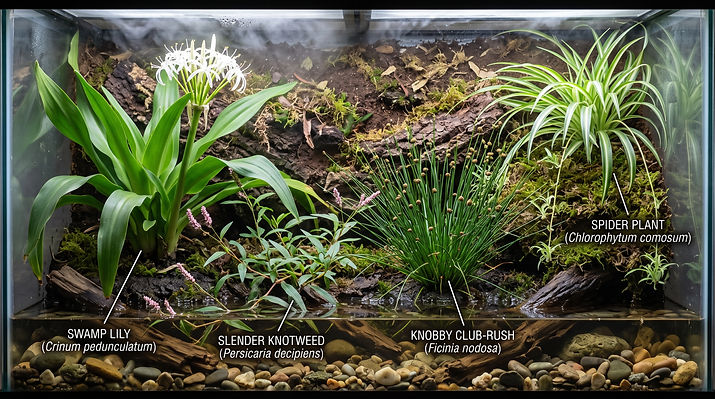
Knobby Club-Rush (Ficinia nodosa)
-
Role: Heavy-Wear Sand Stabilizer & Wire-Stem Screen
-
Placement: Perimeter edges of deep dig zones or banked against rear retaining walls. Features stiff, cylindrical, wire-like stems that resist claw abrasion and heavy scratching, anchored by an exceptionally tight root mat that locks loose sandy substrate firmly in place.
-
-
Common Tussock Grass (Poa labillardierei — compact forms like 'Suggan Buggan')
-
Role: Broad Tussock Shield & Line-of-Sight Break
-
Placement: Cooler corners or mid-enclosure sightline dividers. Forms broad, fountain-like weeping clumps with dense basal crowns that provide physical shelter for resting lizards, resisting flattening even when repeatedly scrambled over.
-

5. Riparian Margins & Billabong Wetlands (Paludarium & Semi-Aquatic)
Submerged & Emergent Stream Anchors (Aquatic to Waterline)
These aquatic and semi-aquatic species root in standing or slow-flowing water, taking up dissolved nitrogenous waste and creating natural escape ramps between land and water.
-
Water Ribbons (Cycnogeton procerum / syn. Triglochin procera)
-
Role: Emergent Waterway Ramp & Waste Biofilter
-
Placement: Shallow water shelves (5–15 cm depth) or bog transition zones. Thick, fleshy strap-like leaves rise directly out of the water, providing a sturdy, non-slip natural ramp for semi-aquatic monitors, water dragons, and frogs moving between the pond and dry land.
-
-
Eel Grass / Ribbon Weed (Vallisneria australis)
-
Role: Submerged Biofilter & Aquatic Hide
-
Placement: Planted in gravel or sand at the bottom of the deep water basin. Fully submerged, long flowing ribbon leaves oxygenate the water column, absorb waste from swimming reptiles, and provide underwater refuge for freshwater keelbacks and tadpoles.
-

Saturated Bog & Shoreline Stabilizers (Mud-Binding Plants & Nutrient Sponges)
These wetland species possess dense, mat-forming root networks that lock shoreline substrates in place, absorb excess nitrates, and prevent claws from causing bank erosion.
-
Spider Plant (Chlorophytum comosum)
-
Role: Nitrate Sponge & Overhanging Bank Draper
-
Placement: Saturated shoreline gravel, bog filter pockets, or mounted ledges directly above the water feature. Its thick, fleshy tuberous roots thrive with constant moisture (often growing bare directly into the water column to strip dissolved waste), while cascading arching leaves drape over the water's edge to provide secure hides for frogs and juvenile dragons.
-
-
Knobby Club-Rush (Ficinia nodosa)
-
Role: Claw-Proof Shoreline Anchor & Wire-Stem Screen
-
Placement: Waterline edges and bog margins. Stiff, round, wire-like cylindrical stems resist claw abrasion, while an aggressive, dense root ball binds wet sand, gravel, and mud to keep banks from collapsing under climbing lizards.
-
-
Swamp Lily / River Lily (Crinum pedunculatum)
-
Role: Heavy-Duty Splash Barrier & Broad Structural Shelter
-
Placement: Deep substrate on elevated banks or rear waterline borders. Massive, thick, leathery upright strap leaves easily shrug off continuous water splashes and the heavy physical impact of adult water dragons clambering out of the water.
-
-
Slender Knotweed (Persicaria decipiens)
-
Role: Creeping Marsh Mat & Floating Frog Perch
-
Placement: Water margins and wet shoreline borders. Sprawls horizontally across the water's surface from rooted bank nodes, creating a floating carpet of soft, non-toxic leaves where bell frogs can rest without sinking.
-
Splash-Zone Lithophytes & Riparian Ferns (Wet Waterfall Borders)
These moisture-loving ferns thrive in constant water spray, wet gravel, and saturated air around filter outlets and waterfalls.
-
Fishbone Water Fern (Blechnum nudum / syn. Austroblechnum nudum)
-
Role: Waterfall Margin Canopy & Humid Hide Cover
-
Placement: Wet rock ledges, waterfall splash zones, and damp stream borders. Stiff, arching fronds form a miniature trunk over time, casting sheltered shade over shoreline hides and handling wet conditions without frond rot.
-
-
Rough Maidenhair Fern (Adiantum hispidulum)
-
Role: Splash-Zone Humidity Buffer & Amphibian Shelter
-
Placement: Shaded rock crevices just above the active water line. Stiff, rough-textured fronds maintain elevated micro-humidity and provide gentle shelter for tree frogs and juvenile dragons without tearing easily.
-

Overhanging Epiphytes (Over-Water Perch Covers)
Mounted onto hardscape timber extending above the water, these canopy plants replicate the overhanging branches wild riparian reptiles and amphibians use for sleeping, basking, and drop-escapes.
-
Elkhorn / Staghorn Fern (Platycerium bifurcatum)
-
Role: Overhanging Basking Shield & Arboreal Canopy
-
Placement: Mounted directly to cork tubes or driftwood branches suspended over the water basin. Broad, nest-like shield fronds anchor tightly to wet timber and provide visual cover directly above the billabong where water dragons and monitors prefer to sleep.
-
-
Native Bird’s Nest Fern (Asplenium australasicum / A. nidus)
-
Role: Broad Rosette Canopy & Droplet Funnel
-
Placement: Mounted in branch forks or cork hollows directly overhanging the water feature. Radiating, upright leathery fronds form an expansive umbrella over the pool, creating sheltered roosting sites for tree frogs (Litoria spp.) and funneling overhead spray down to lower perches.
-
-
Rock Lily / King Orchid (Thelychiton speciosus / syn. Dendrobium speciosum)
-
Role: Rigid Over-Water Basking Perch & Air Root Anchor
-
Placement: Mounted on high, well-lit branches overhanging open water zones. Massive, woody pseudobulbs and thick leathery leaves easily support the physical weight of larger perching lizards, while aerial roots absorb rising humidity from the water below.
-
-
Bromeliads (Neoregelia, Guzmania, Vriesea)
-
Role: Canopy & Perch Shielding
-
Placement: Mount into background pockets or secure with floral wire/zip ties directly onto branches near horizontal perches. Their central leaf cups hold misted water, elevating microclimate humidity right where the python rests.
-

The Living Equilibrium: Maintaining Flora in the Bioactive Enclosure
Creating a thriving planted vivarium is an ongoing balance between botanical horticulture and animal husbandry. A bioactive enclosure is not a static display—it is an evolving, living micro-habitat where plants root, establish, take physical wear, and regenerate alongside the animals that share their space.
As you finalize your plant selections and begin planting your biome, keep these core principles in mind:
Expect Attrition and Plan for Growth
Even the most durable plants will experience crushed leaves, snapped tips, or displaced soil as reptiles establish their daily basking routines and nocturnal patrol routes. This mechanical wear is completely natural.
-
Give plants a head start: Whenever possible, allow plants to establish in the enclosure for 3 to 6 weeks before introducing heavy-bodied pythons, monitors, or active skinks. A well-rooted plant with anchored roots into the drainage mesh or background can withstand significantly more physical impact than a freshly potted plant.
-
Prune strategically: Trim away damaged, yellowing, or decaying foliage promptly. In a bioactive setup, small amounts of leaf matter feed your springtails and isopods, but heavy decomposing vegetation under basking heat can encourage unwanted mold blooms before the custodial cleanup crew has scaled to manage it.
Light and Drainage: The Invisible Lifelines
The single most common reason live plants fail in reptile enclosures is not animal damage, but inadequate light or waterlogged roots.
-
Reptile lighting alone is rarely enough: Standard heat lamps and ambient UVB tubes do not provide the photosynthetically active radiation (PAR) required for long-term plant growth. Always pair your reptile heating and UVB systems with a dedicated, high-CRI, 6500K full-spectrum LED bar spanning the length of the planted zone.
-
Protect the root zone: A proper drainage layer separated by a fine synthetic mesh barrier, is mandatory in tropical, woodland, and riparian setups. Enclosure substrate should remain moist and well-aerated, never saturated or stagnant, to prevent root rot. This will also keep the set up from smelling like a bog! HOWEVER: The drainage layer type will depend heavily on the species. Leca clay balls are a fantasic drainage layer, but they can have some risks to lizards. I have personally experienced one of my female green tree monitors eating the leca and luckily she didnt need surgery. However needing surgery is a very common occurnace. So if you are planning on having a bioactive set up for a monitor or many other lizards, consider egg crate, thick aquarium sponges and other similar materials to create the drainage layer. This will ensure the lizard cannot get to the leca/pebbles and remain safe.
Safety Remains the Absolute Priority
Whether you are curating broad, mist-catching foliage for an arboreal Green Tree Python, chew-safe native succulents for a grazing Bearded Dragon, or skin-safe micro-ferns for delicate tree frogs, safety always precedes aesthetics. Never rush the bare-root wash, quarantine period, or pesticide clearance. Taking the time to properly strip nursery chemicals protects the sensitive respiratory systems, digestive tracts, and semi-permeable skin of your animals.
By selecting flora native or climatically suited to your species' wild habitat, you do more than decorate a glass box—you replicate the natural tactile surfaces, cryptic humidity microclimates, and sensory stimulation that allow Australian reptiles and amphibians to thrive.